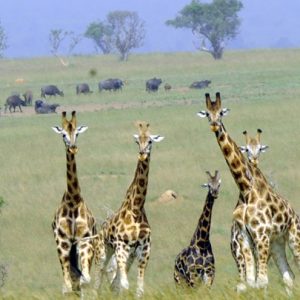
Nestled in the western region of Uganda, straddling the equator in the Albertine rift valley between lake George and Edward, Queen Elizabeth national park stands as one of Africa’s most bio diverse and captivating safari destinations.it offers stunning mosaic of savannas , wetlands , forests, and waterways set against the dramatic backdrop of the Rwenzori mountains. it encompasses the elusive tree climbing lions and the hippo filled waters of the Kazinga channel .
whether you seek the trill of spotting the tree climbing lions , cruising past the pods of hippos , tracking chimpanzee
,or simply soaking in the raw beauty of the African wilderness ,QENP delivers an unforgettable experience. Its proximity to other attractions like Kibale national park makes it an ideal stop on multi park itineraries.
EXTRA ORDINARY DIVERSITY
The Kazinga channel linking lake George to lake Edward forms an ecological heart of the park. it supports one of the highest concentrations of wildlife in Africa. the Rwenzori mountains provide a majestic , often mist shrouded backdrop ,adding to the park’s dramatic appeal.
MORE THEN JUST THE BIG FIVE.
BIRDING PARADISE :Queen Elizabeth national park is nothing short of spectacular. with over 600 bird species including the elusive shoe bill stork, flamingos , the park offers endless opportunities for birding, the Kazinga channel is a prime location for spotting water birds, including the pelicans, kingfishers, and herons while the Maramagambo forest is haven for the forest dwelling species.
CHIMPANZEE TRACKING IN KYAMBURA GORGE ; Beyond the savanna ,the park offers a unique opportunity to track chimpanzees in the kyambura gorge. this 100 meter deep ”valley of apes” is a lush , forested ravine in the eastern part of the park of the park that is a home to a small, habituated community of chimpanzees guided trek into the gorge is a moderately challenging but highly rewarding experience.
TREE CLIMBIMG LOINS OF ISHASHA: Perhaps the park’s most extraordinary claim to fame lies in its southern Ishasha region . here you will one of only 2 places in Africa where loins routinely climb trees. Unlike other lions, these climb fig tress to rest during the heat of the day and scan for prey like Uganda kob. this rare behavoir makes ishasha a bucket list destination.
.
The Tree-Climbing Lions of Ishasha
Perhaps the park’s most extraordinary claim to fame lies in its southern Ishasha sector. Here, you will find one of only two places in Africa where lions routinely climb trees. Unlike their counterparts on the plains, the Ishasha lions are often found lazily draped over the branches of ancient fig and acacia trees, a behaviour that remains a mystery to scientists and a thrill for visitors . Whether they are escaping the tsetse flies at ground level, seeking a cool breeze, or scouting for prey, seeing these magnificent creatures resting among the branches is a truly surreal and unforgettable experience.
Chimpanzee Tracking in Kyambura Gorge
Beyond the savannah, the park offers a unique opportunity to track chimpanzees in the Kyambura Gorge. This 100-metre-deep “Valley of Apes” is a lush, forested ravine in the eastern part of the park that is home to a small, habituated community of chimpanzees . A guided trek into the gorge is a moderately challenging but highly rewarding experience. While sightings are not guaranteed—with around a 60% success rate—the chance to observe these great apes in their natural habitat is a profound experience that underscores Uganda’s prominence as a primate destination .
Birding Paradise
For birdwatchers, Queen Elizabeth National Park is nothing short of spectacular. With over 600 recorded species, including the elusive shoebill stork, great flamingos, and the iconic African fish eagle, the park offers endless opportunities for birding. The Kazinga Channel is a prime location for spotting water birds, including pelicans, kingfishers, and herons, while the Maramagambo Forest is a haven for forest-dwelling species .
Experiences: Safari Activities to Remember
A safari in Queen Elizabeth is an immersive experience, offering far more than just a game drive.
Game Drives: The classic safari activity is best enjoyed at dawn or dusk on the Kasenyi Plains, where predators are most active. Night game drives are also available for those hoping to spot the park’s nocturnal residents like leopards, hyenas, and bush babies .
Boat Safaris: A boat cruise along the Kazinga Channel is an absolute must-do. The 2-hour cruise brings you face-to-face with hundreds of hippos, basking Nile crocodiles, and a dazzling array of water birds. Watching elephants and buffaloes come to the water’s edge to drink as the sun sets is a highlight for many visitors .
Nature Walks: For a different perspective, guided nature walks are available in areas like the Maramagambo Forest. Here, you can explore on foot, learning about the smaller inhabitants of the park, such as primates, reptiles, and butterflies, while the armed ranger guide shares insights into medicinal plants and local legends .
Planning Your Journey
Queen Elizabeth National Park is accessible by both road and air, located approximately 400 kilometres from the capital, Kampala . The road journey takes about 6-7 hours, while chartered flights from Entebbe to the Mweya Airstrip can reduce travel time to just over an hour .
The best time to visit is during the dry seasons from June to September and December to February, when animals congregate around water sources and roads are easier to navigate . However, the park is a year-round destination, and the wet seasons offer lush scenery, excellent birdwatching with migratory birds, and fewer tourists .
Plan your travel with INSIPIRE AFRICAN SAFARIS
Queen Elizabeth National Park is more than just a safari destination; it is a microcosm of Africa’s wild beauty. From the roar of a lion on the Kasenyi Plains to the gentle splash of a hippo in the Kazinga Channel, every moment spent here is a reminder of the raw, untamed spirit of the continent. It is an experience that will linger long after you have left its shores.