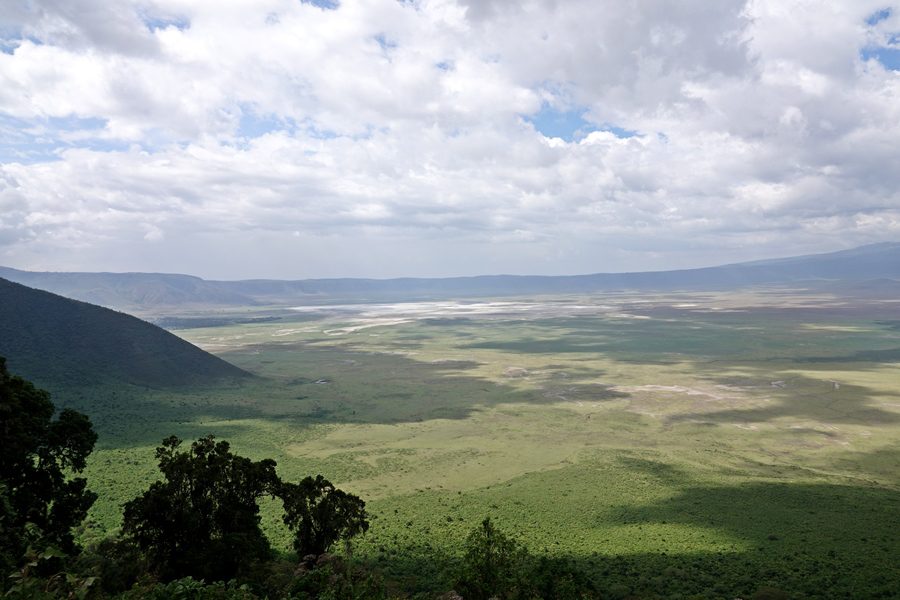
Take almost 30,000 large mammals and place them inside the crater of an extinct volcano. Add about 264 square kilometres (102 square miles) of wetlands, forests and grasslands, and the result is the Ngorongoro Crater. This world-famous safari destination offers its visitors superb game viewing in an unbelievably unique setting. Nothing can fully prepare you for the moment you first gaze down into the Ngorongoro Crater.
The Crater is located within the Ngorongoro Conservation Area, a protected region in Tanzania that comprises a large chunk of the southern Serengeti’s short-grass plains and the Ngorongoro Highlands, a range of ancient volcanoes on the west side of the Great Rift Valley. The Ngorongoro Crater has earned a fabled reputation as one of Africa’s most unique natural wonders, boasting a remarkable concentration of animals living in diverse habitats.
But how was the Ngorongoro Crater created? And what is so unique about Ngorongoro Crater? We answer these questions and share our favourite facts about Ngorongoro Crater in this handy guide…
Frequently Asked Questions About Ngorongoro Crater
1. How Was the Ngorongoro Crater Created?
The Ngorongoro Crater is thought to have formed about 2.5 million years ago when an active volcano’s cone collapsed inward after a massive eruption. The enormous, unbroken caldera we see today is the main remnant of this implosion.
2. What is a Caldera?
Spanish for ‘cauldron’, a caldera is a bowl-shaped volcanic cavity that’s usually more than one kilometre (0,6 miles) in diameter, with an outer edge formed by steep slopes. A caldera is generally formed when the top of a volcanic cone (or group of cones) collapses because it’s no longer supported by an underlying body of magma.
After all the major eruptions are complete, the top of the volcanic mountain will have disappeared, leaving a gigantic hole in its place. Minor eruptions could happen after the major implosion and create smaller cones in the caldera’s floor. These may later fill up with water to form lakes.
3. What is Unique About Ngorongoro Crater?
Other than being the biggest intact (unbroken) volcanic caldera on Earth, the Ngorongoro Crater is also a natural sanctuary for some of the densest populations of large mammals in Africa. Due to its enclosed nature, the Ngorongoro Crater has effectively formed its own ecosystem.
4. How Old is Ngorongoro Crater?
It is believed to be between two and three million years old.
5. What is Ngorongoro Crater Known For?
It is renowned for its geological splendour and the variety of fauna and flora found in an astonishingly compact area. You are guaranteed to see big concentrations of animals on a game drive in the Ngorongoro Crater. The Crater also delivers some of the most reliable sightings of the Big 5 (elephant, buffalo, rhino, lion and leopard) in East Africa.
6. What Does Ngorongoro Mean in English?
Ngorongoro is believed to be an onomatopoeic word termed by the Maasai people of the region to describe the sound of the bell that hangs around the neck of the lead cow in a herd. The bell makes an echoing “ngor ngor” sound, which made the local pastoralists name the area Ngorongoro.
7. When is the Best Time to Visit Ngorongoro Crater?
As the wildlife remains within the steep-walled caldera all year round, the question of when to go to Ngorongoro Crater is less about optimising your game viewing experience and more about how many other people and vehicles you want to share the Crater with. The dry season months are between June and October when temperatures are cooler and animal sightings are superb – it’s easy to spot them along the barren plains and they don’t wander far from watering holes. But this is also peak safari season when throngs of tourists flock here from all over the world.
Tanzania’s two rainy seasons are from April to May and November to December. Temperatures are warm and the roads around the caldera can get rather muddy. But there are far fewer visitors during the wet seasons and the Ngorongoro Crater transforms into a wonderfully lush, emerald ‘Garden of Eden’.
Facts About Ngorongoro Crater
1. The World’s Biggest Intact Volcanic Caldera (That’s Not a Lake)

The Ngorongoro Crater is approximately 16 to 19 kilometres (10 to 12 miles) in diameter, and the height of its walls ranges between 400 and 610 metres (1,312 and 2,000 feet) – more than 1.5 times higher than the Empire State Building. There are a few calderas around the world, but the Ngorongoro Crater is unique because it’s the biggest one with fully intact (unbroken) walls and hasn’t filled up with water.
2. One of the Seven Natural Wonders of Africa