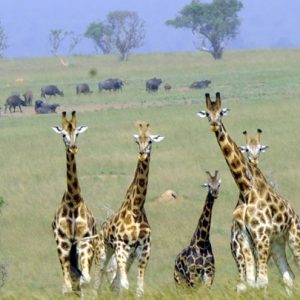
An oasis in the semi-desert, Kidepo Valley National Park covers 1,442 square kilometers of the spectacular Narus Valley. Dramatic mountains and rocky outcrops surround beautiful expanses of savanna and forest.

Introduction
An oasis in the semi-desert, Kidepo Valley National Park covers 1,442 square kilometers of the spectacular Narus Valley. Dramatic mountains and rocky outcrops surround beautiful expanses of savanna and forest, with bubbling hot springs as a reminder of its volcanic past.
Uganda is now a popular tourism and wildlife destination, but Kidepo remains relatively unknown, tucked away in the far northern reaches of Uganda near the border with South Sudan.
Although many of the animals were driven away in the 1980’s and 90’s by tribal warfare, wildlife is once again thriving in Kidepo. Almost 500 bird species and 86 mammal species call this park home, including spotted hyena, lion, cheetah, leopard, elephant, giraffe, zebra, African buffalo, bat-eared foxes, Rothschild’s giraffe. Buffalo herds can number over 3000 and lions are plentiful, but now restricted to the park.
The region also includes the IK tribe, an isolated tribe living in the nearby hills. The IK are one of the smallest ethnic groups in Africa, and may have come from Ethiopia hundreds of years ago.
Threats to Kidepo
In Kidepo, protected area management needs to be improved. Currently, operations and staff are only based within the national park, yet wildlife spends 50% of its time outside. Poaching outside of the park is high.
For UWA to have a successful programme outside of the park, and transboundary management connecting to the Northern Rangeland Trust conservancies in Kenya, UWA’s core management capability must be expanded beyond the park.
The foundations of protected area management must be established at Kidepo HQ, including the Joint Operations Command Centre and a digital radio system that covers the park as well as areas outside. In addition, UWA’s capabilities (initially put in 4 to 5 decades ago) must be aligned to the threats of today, as well as the protected area’s vital interests and priorities.
Until now, UWA has simply used what facilities have existed. There are no communications and operations management systems to support effective real time management. UCF is working with UWA and other partners such as the Northern Rangeland Trust in Kenya to develop a successful transboundary conservation programme.
Saving Kidepo
Due to COVID, the Uganda Wildlife Authority has lost over 95% of its revenue base from tourism. UWA is now operating on 15% of its operational budget. In Murchison Falls and Queen Elizabeth Protected Areas, UCF has been providing operational support including fuel for operations (anti-poaching, problem animal control and veterinary rescues), patrol food, basic maintenance of operational motorbikes, boats and cars, and ranger equipment.
UWA has requested UCF supports Kidepo Valley by installing the same foundations of park management as in Murchison Falls & Queen Elizabeth National Parks. This includes the Joint Operations Command Centre, digital radio network, and EarthRanger.
This will allow for the imminent expansion of conservation well beyond the boundaries of the park. UCF and UWA are currently working with Ian Craig and the Northern Rangeland Trust in Kidepo on plans to expand the success of NRT’s 40+ conservancies across the border into north-east Uganda, linking and protecting the considerable landscapes for both communities and wildlife.