Visit the Equator at Kayabwe, Uganda because it allows you to stand with one foot in the Northern Hemisphere and the other in the Southern Hemisphere, providing a unique experience of being on both sides of the world at once; you can also participate in demonstrations showcasing how water drains differently in each hemisphere due to the Coriolis effect, take photos at the equator marker, and explore local shops selling souvenirs and crafts
The equator crossing in Uganda is a classic spot for pictures, and souvenirs, and a perfect stopover for any safari to Western and southwestern Uganda.
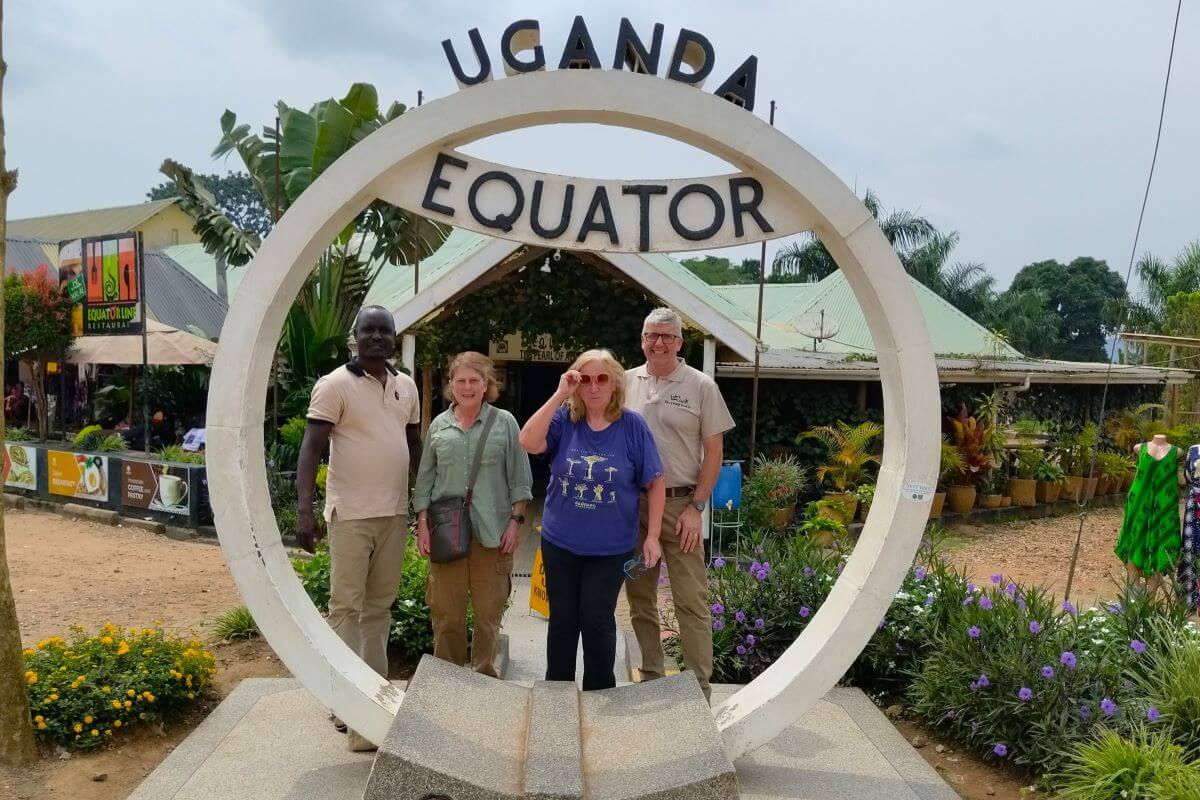
Uganda is one of the countries in the world that is crossed by the equator – the imaginary line that cuts Earth into the northern and southern hemispheres. While the Equator crosses through all of Uganda, the most Iconic spot for the equator crossing is in Kayabwe, just 70 kilometers from Kampala city.
At Kayabwe, the Equator line crosses the Kampala – Masaka highway making it an easy stop for some equator science experiences and experiments. It has become a popular stop for anyone going to visit the popular national parks of western Uganda.
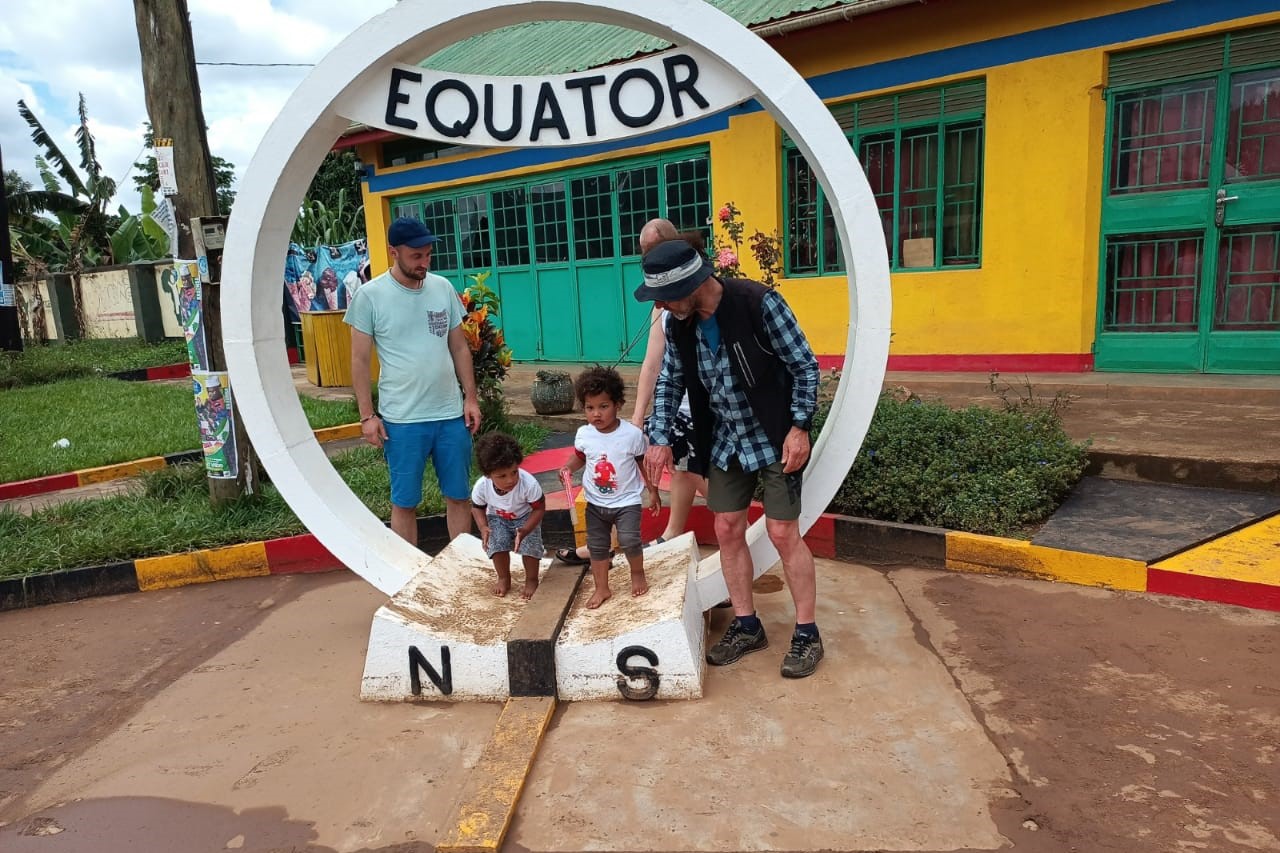
While Uganda has so many places to visit and take pictures, pictures taken at the equator line have an iconic feeling to them and they will become your favorites. For many visitors, being able to stand in 2 hemispheres and feel a bit lighter is a wonderful experience to add on top of their Uganda safari holiday.
Being crossed by the equator is the simple explanation for why Uganda has a warm equatorial climate with even days and nights and lush landscapes. The equator line can be crossed on your way to visit any of the national parks in southwestern Uganda, such as Lake Mburo, Queen Elizabeth, and Bwindi Impenetrable.
There are several craft shops and art galleries at this place on Masaka Road. With products that have been locally made by individuals and organizations that are around the equator area.
Most of the tourists have found it an awesome place to get a souvenir to take back home and tell their people how they crossed the Equator in Uganda.
Water experiments at the equator
Did you know at the equator water drains straight down? This is because the movement and drainage of the water will differ from the Northern and the Southern hemispheres at the Equator line, in the demonstration of the carioles effect.
With a movement that changes direction suddenly, something in motion to the left or right when moving on a rotating body like the earth. In some cases pressure weather cyclonical systems perform this, having a clockwise rotation in the north and a counterclockwise in the southern hemisphere.
From a realistic perspective, you may not be able to see this as motion would not be seen with water in small amounts. Showmanship is used to simulate the effect.
While in the northern hemisphere, the water will drain down the hole in a clockwise direction. Water will drain in the counterclockwise direction in the southern hemisphere.
Lighter weight
It’s true, you will find out that you are 3% lighter at the equator line. Why? This comes about because weight is a force with which gravity acts on a mass.
Along the equator line, anyone’s weight will be less by 0.5% thus gravity is 0.5 % less at the Equator. This is inclined to the earth not being a perfect sphere. At the poles, it is flattened.
You will be a few tens of kilometers away from the actual center of the earth while standing at the equator unlike when standing at the poles. Gravity is therefore only slightly less at the equator because it falls off with distance.
Frequently Asked Questions
1: Where is the equator in Uganda?
The equator cuts through Uganda from west to east and crosses many districts. The equator point at Kayabwe is however the most popular because it crosses the Kampala-Masaka highway. The spot is extremely popular that is has become the iconic stop for photos, coffee, and souvenirs for most tourists who are using the road.